
What Are FAST Channels?
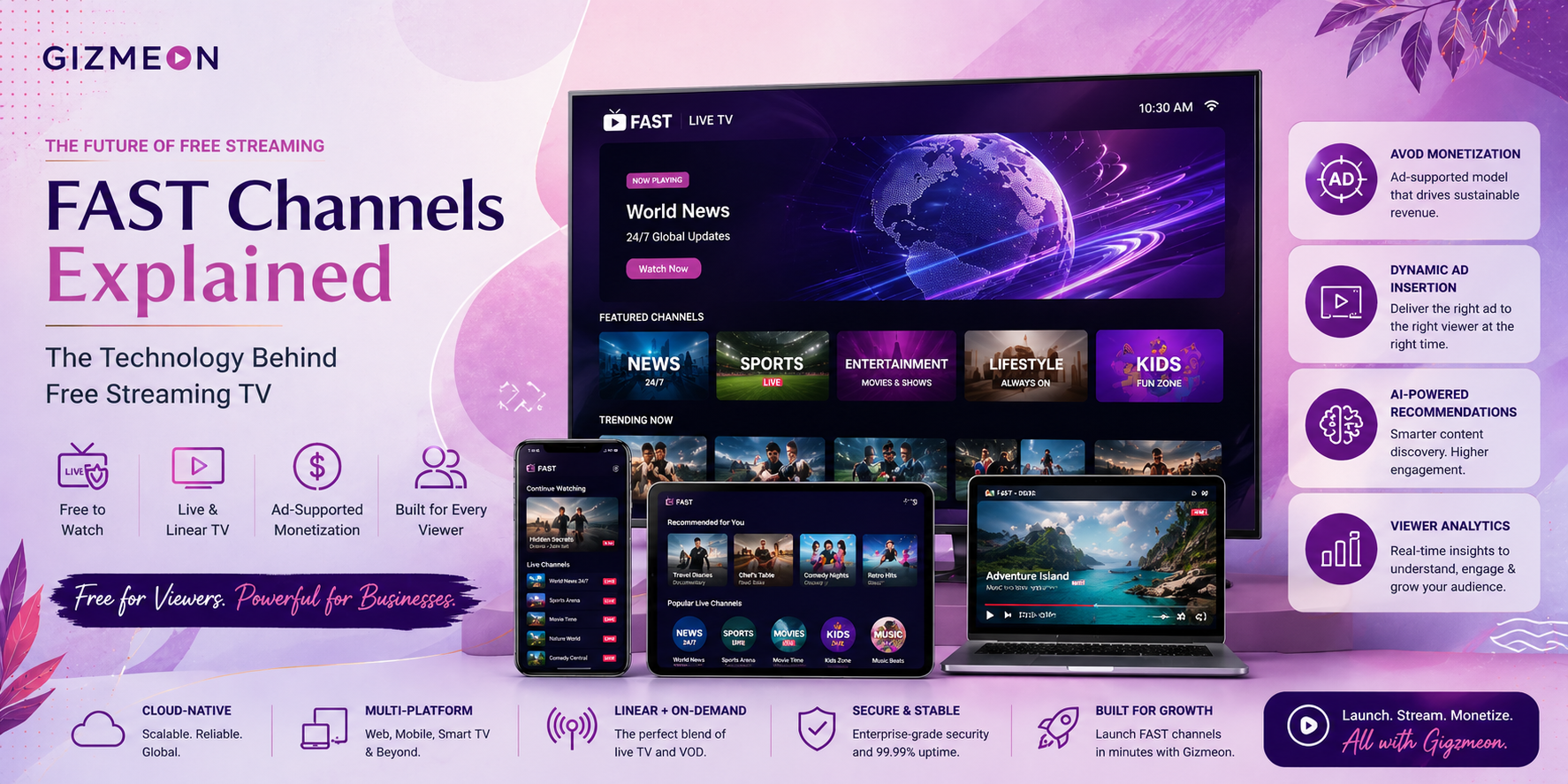
FAST stands for Free Ad-Supported Streaming TV. In simple terms, FAST channels are streaming channels that allow users to watch content for free while revenue is generated through advertising. Instead of selecting individual videos from an on-demand library, viewers tune into always-on channels that play continuously—similar to traditional cable television. This format feels familiar because it mirrors the traditional TV experience, but it operates on digital OTT infrastructure. Popular examples of FAST platforms include:- Pluto TV
- Tubi
- Samsung TV Plus
- Roku Channel
- Amazon Freevee
Why FAST Channels Are Growing So Quickly
The rapid growth of FAST channels is not accidental—it is the result of changing viewer behavior and market economics. The first major reason is subscription fatigue. Consumers are overwhelmed by the number of paid streaming services available today. Managing multiple subscriptions has become expensive, and many viewers are actively looking for free alternatives without sacrificing content quality. FAST solves this problem by offering premium viewing experiences without a monthly fee. The second reason is advertising. Traditional television advertising has lost much of its precision. Advertisers now want digital targeting, measurable performance, and audience segmentation—something FAST channels deliver far better than legacy broadcast systems. Because FAST runs on OTT infrastructure, advertisers can benefit from better data, improved personalization, and stronger ROI. The third reason is content monetization. Broadcasters and publishers often sit on massive libraries of evergreen content that no longer generate significant value through traditional channels. FAST allows these assets to be repackaged into profitable streaming channels. This makes FAST highly attractive for:- broadcasters
- media companies
- publishers
- sports networks
- regional content owners
- creator-led platforms
The Technology Behind FAST Channels
While FAST feels simple for viewers, the backend technology is what makes it successful. A FAST channel is not just a playlist of videos running continuously. It requires a structured system that manages content flow, scheduling, ad delivery, playback quality, and audience engagement. Several technologies work together to make this possible.Linear Channel Scheduling
At the core of FAST is linear programming. Content must be scheduled like a television channel, where shows, movies, and live events run continuously in a planned sequence. This requires automated scheduling systems that manage programming logic, content rotation, and audience behavior patterns. Unlike VOD platforms where users choose content manually, FAST depends heavily on smart programming. The goal is to keep users watching longer by structuring content in a way that feels natural and engaging.Cloud Playout and Content Delivery
Modern FAST platforms rely on cloud playout systems instead of traditional broadcast hardware. This means channels can be created, managed, and distributed digitally without the limitations of physical infrastructure. Cloud playout improves scalability, reduces operational costs, and allows businesses to launch channels much faster. Content is then delivered through CDNs (Content Delivery Networks), which ensure smooth playback across regions and devices. This is critical because buffering and poor playback directly reduce watch time and ad revenue.Dynamic Ad Insertion
One of the most important technologies in FAST is Dynamic Ad Insertion (DAI). Instead of inserting the same ad for every viewer, DAI allows ads to be personalized based on audience behavior, location, interests, and demographics. This improves:- viewer experience
- advertiser performance
- monetization efficiency
Viewer Analytics and Data Intelligence
FAST platforms generate valuable viewer insights. Analytics help businesses understand:- what content performs best
- when users drop off
- which channels retain viewers longer
- what ad formats convert better
How FAST Channels Make Money
Many people assume free streaming means lower revenue potential, but in many cases, FAST channels can outperform subscription-only models. The primary monetization model is AVOD (Ad-Supported Video on Demand), where advertising drives revenue instead of monthly subscriptions. Revenue comes from:- pre-roll ads
- mid-roll ads
- branded sponsorships
- display placements
- premium ad packages
- FAST channel sponsorships
FAST Channels vs Traditional OTT Platforms
Businesses often ask whether they should launch a FAST channel or a traditional OTT platform. The answer depends on goals. Traditional OTT platforms are ideal for:- premium subscriptions
- direct customer ownership
- exclusive content access
- long-term subscriber relationships
- broad audience reach
- free user acquisition
- ad-supported monetization
- archived content monetization
- discovery-driven growth
How AI Makes FAST Channels Smarter
Artificial Intelligence is quietly becoming one of the biggest drivers of FAST channel performance. AI improves FAST by helping platforms make better decisions faster. This includes:- smarter content recommendations
- better ad targeting
- audience segmentation
- churn prediction
- optimized scheduling
- personalized channel suggestions
How Gizmeon Helps Launch and Scale FAST Channels
Launching a successful FAST channel requires more than just content—it requires the right platform infrastructure. This is where Gizmeon creates real strategic value. Gizmeon enables broadcasters, content owners, and media businesses to launch fully branded FAST channels alongside traditional OTT platforms from one unified ecosystem. Instead of managing fragmented systems, businesses can operate:- FAST channels
- Live streaming
- VOD libraries
- Linear TV channels
- White-label OTT apps
- Multi-device streaming across Web, iOS, Android, Roku, Fire TV, and Apple TV
- AVOD
- SVOD
- TVOD
- PPV
- Hybrid FAST + OTT models