
The streaming industry has evolved rapidly, and businesses today face a critical decision: FAST channels vs OTT platforms—which model delivers better results?
In 2026, this is no longer just about choosing between free or paid content. Instead, it’s about building a scalable streaming strategy that combines audience acquisition, monetization, and long-term retention.
Whether you are a broadcaster, content owner, media company, or creator, understanding the difference between FAST vs OTT platforms is essential to building a successful streaming business.
What Are Traditional OTT Platforms?
Traditional OTT (Over-The-Top) platforms are streaming services where users access content through apps or websites, usually via subscriptions or one-time payments.
These platforms typically use monetization models such as:
- SVOD (Subscription Video on Demand)
- TVOD (Transactional Video on Demand)
- PPV (Pay-Per-View)
- Premium memberships
Unlike third-party platforms, OTT services give businesses full ownership over their content, audience data, and revenue streams.
This makes OTT platforms ideal for:
- Sports streaming platforms
- Educational content providers
- Fitness and coaching businesses
- Faith-based networks
- Creator-led subscription platforms
The biggest advantage of OTT is control. You are not just distributing content—you are building a long-term digital asset.
What Are FAST Channels?
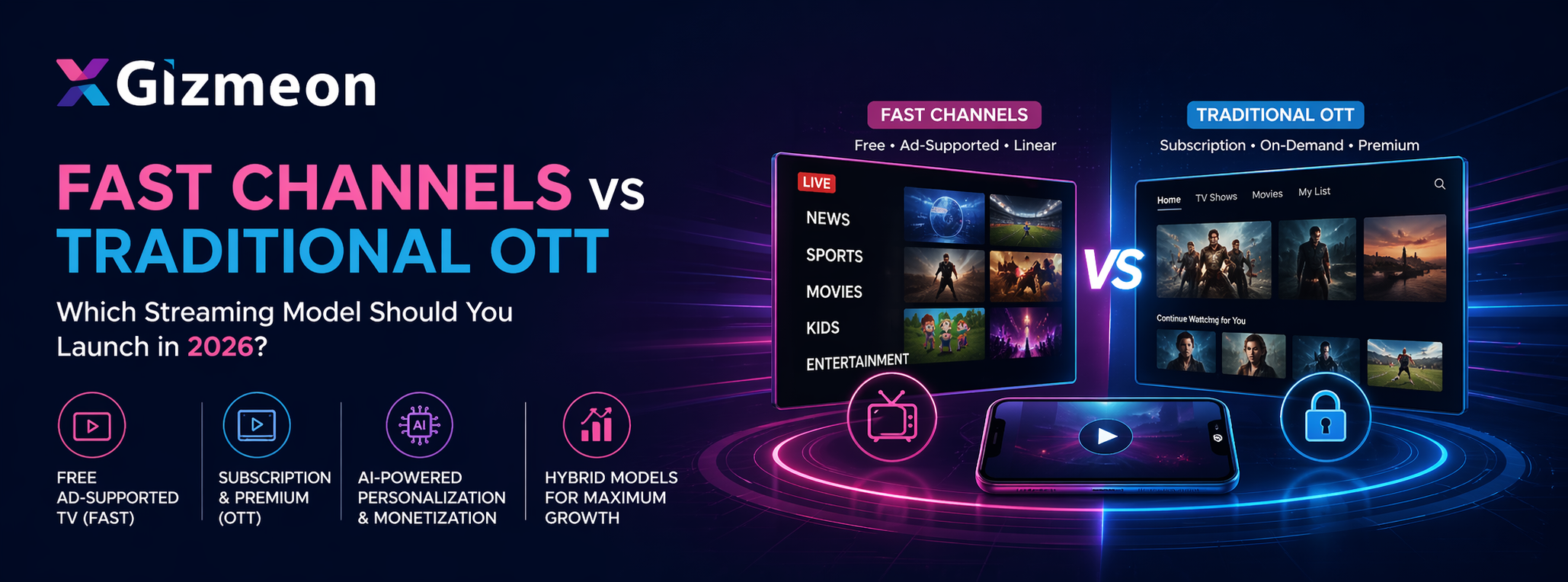
FAST (Free Ad-Supported Streaming TV) channels are linear streaming channels where users watch content for free while revenue is generated through advertising.
Unlike OTT platforms, FAST channels follow a lean-back viewing experience, similar to traditional television. Users simply tune in and watch scheduled programming.
FAST channels are growing rapidly due to increasing subscription fatigue, where users are no longer willing to pay for multiple streaming services.
This model works best for:
- Broadcasters with large content libraries
- Media companies with archived content
- Publishers and digital networks
- Brands looking for wider reach
FAST channels prioritize audience scale and discoverability, making them a powerful entry point into the streaming ecosystem.
FAST Channels vs OTT Platforms: Key Differences
When comparing FAST channels vs OTT platforms, the differences go beyond monetization.
- OTT platforms focus on ownership and recurring revenue
- FAST channels focus on reach and ad-based monetization
OTT platforms aim to convert users into paying subscribers, while FAST channels aim to attract large audiences quickly.
In simple terms:
- OTT = Long-term customer value
- FAST = Audience growth and discovery
Neither model is better on its own. The right choice depends on your business goals.
Why Hybrid FAST + OTT Models Are Winning in 2026
The most successful streaming businesses today are not choosing between FAST vs OTT—they are combining both.
A hybrid model allows you to:
- Use FAST channels for audience acquisition
- Use OTT platforms for premium monetization
- Diversify revenue streams
- Reduce dependency on a single model
For example, a user may discover your content through a FAST channel and later subscribe to your OTT platform for exclusive content.
This creates a complete monetization funnel:
- Free content → Engagement → Subscription → Retention
As subscription fatigue continues to rise, hybrid models are becoming the most sustainable strategy.
How AI Is Transforming FAST and OTT Platforms
Artificial Intelligence is reshaping how streaming platforms operate.
In OTT platforms, AI helps:
- Deliver personalized recommendations
- Improve user retention
- Predict churn
- Automate subtitles and metadata
In FAST channels, AI enhances:
- Ad targeting and monetization
- Audience segmentation
- Content scheduling
- Programming optimization
Most importantly, AI enables platforms to track how users move between FAST and OTT, improving conversion rates in hybrid models.
FAST vs OTT for Creators and Vertical Video Platforms
The rise of the creator economy has changed how streaming platforms are built.
Creators are moving away from relying entirely on platforms like YouTube and instead launching their own OTT platforms.
However, FAST channels still play a key role in content discovery.
Short-form and vertical video content are especially effective for:
- Attracting new audiences
- Increasing ad-supported engagement
- Driving users into premium ecosystems
This combination of FAST discovery and OTT monetization is becoming the standard approach for creator-led platforms.
How to Choose Between FAST Channels vs OTT Platforms
Choosing between FAST channels vs OTT platforms depends on your business strategy.
Choose OTT if you want:
- Subscription revenue
- Full audience ownership
- Premium content monetization
Choose FAST if you want:
- Rapid audience growth
- Free content distribution
- Ad-based revenue
Choose a hybrid model if you want:
- Multiple revenue streams
- Scalable growth
- Long-term sustainability
For most businesses in 2026, hybrid is the smarter choice.
Launch FAST and OTT Platforms with Gizmeon
Modern streaming businesses need flexibility—not limitations.
Gizmeon enables you to launch:
- Fully branded OTT apps (web, mobile, Smart TV)
- FAST channels and linear streaming
- VOD and live streaming platforms
- Hybrid monetization models
With built-in AI capabilities, Gizmeon helps improve:
- Content discovery
- Personalization
- Ad optimization
- Audience retention
Instead of choosing between FAST vs OTT, you can build both—within a single scalable ecosystem.
Frequently Asked Questions
What is the difference between FAST and OTT platforms?
FAST channels are free and supported by ads, while OTT platforms typically rely on subscriptions or pay-per-view models.
Are FAST channels better than OTT platforms?
Not necessarily. FAST is better for reach, while OTT is better for monetization and ownership.
Can FAST and OTT work together?
Yes. Hybrid models combining FAST and OTT are the most effective strategy for modern streaming businesses.
What is the best streaming model in 2026?
Hybrid streaming models that combine FAST and OTT offer the best balance of growth, monetization, and scalability.