
The Difference Is Not Distribution. It Is Control.
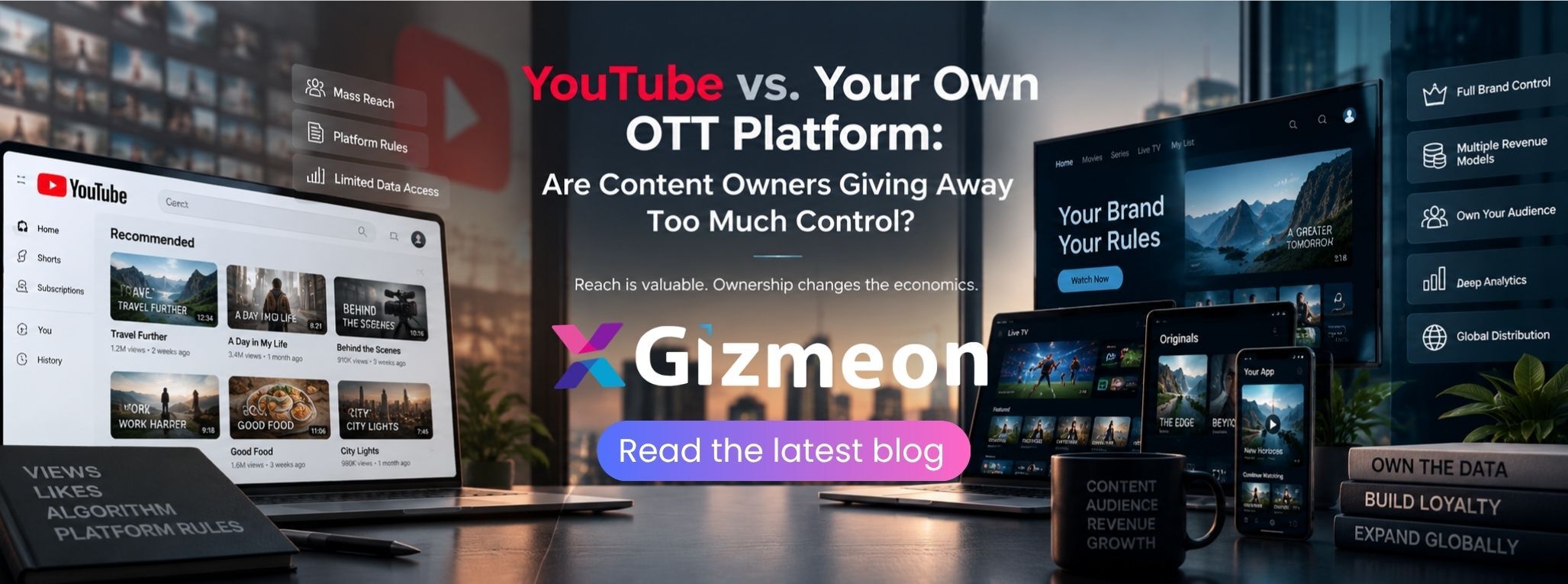
The traditional comparison between YouTube and OTT platforms often focuses on reach versus ownership, but the business difference goes deeper. YouTube is exceptionally effective at discovery. Its recommendation system, search infrastructure, creator ecosystem and enormous existing audience allow content to find viewers without a media company having to build that audience from scratch. YouTube’s Partner Program now includes more than three million creators, and the company says viewers watch more than one billion hours of YouTube on television every day. For a content owner, that distribution capability has obvious economic value. It can support audience acquisition, advertising, brand development and testing of new formats at enormous scale. A new series can be published, measured and optimized without first building an independent streaming service. The strategic limitation is that distribution does not automatically create ownership of the entire commercial environment around that audience. An owned OTT platform allows the business to determine how viewers encounter its catalogue, how content is packaged, which programming is premium, how advertising is sold, how subscriptions are structured and how different audience segments are monetized. That distinction becomes increasingly important as content businesses mature. A YouTube channel is fundamentally a channel within a much larger ecosystem. An OTT service can become the operating environment for the content business itself.The Revenue Model Changes When the Platform Is Yours
The most significant difference may ultimately be financial rather than technological. YouTube offers sophisticated monetization through advertising, memberships, fan-funding products, Shopping and YouTube Premium revenue sharing. Its current Partner Program changes also show how quickly platform-level monetization models can evolve as the creator economy develops. An owned OTT platform introduces a different commercial architecture. Instead of building the entire business around one monetization mechanism, a content owner can combine subscription video-on-demand, advertising-supported video-on-demand, transactional video-on-demand, pay-per-view, FAST channels and hybrid models according to the characteristics of its audience and content library. That flexibility matters because streaming economics are becoming increasingly diversified. “Deloitte’s 2026 Digital Media Trends found that 68% of streaming subscribers surveyed now pay for at least one ad-supported streaming service, while 61% said they would cancel their favorite streaming service if its monthly price increased by $5.” The findings point to a market in which consumers are increasingly sensitive to subscription pricing and more comfortable with advertising-supported alternatives. For content owners, this creates a commercial opportunity beyond simply choosing between advertising and subscriptions. A premium series might support SVOD. A major live event might work better as TVOD or PPV. A large back catalogue might generate incremental value through AVOD. A library of evergreen programming could become a FAST channel. The same underlying content assets can therefore participate in several revenue models without being treated as one undifferentiated product.The Content Library Becomes a Portfolio
This is one of the biggest strategic differences between operating a channel and operating a streaming business. On a third-party video platform, individual videos often compete for attention within a continuous recommendation and discovery environment. An owned OTT service can organize the same assets into a much broader commercial portfolio. A media company can create collections, channels, seasons, premium windows, live programming, free libraries and subscriber-only experiences around the same catalogue. This becomes particularly powerful when combined with connected TV. In the US, streaming accounted for 49% of total television usage in Nielsen’s July 2026 measurement, while YouTube alone reached 14.2%. In Europe, connected TV is also becoming an increasingly important advertising environment: FreeWheel’s H2 2025 data showed CTV accounting for 86% of premium video ad views in the US and 50% in Europe. The implication for content owners is significant. A content library no longer has to be thought of simply as a collection of programmes to distribute. It can be structured as a portfolio of monetizable assets across screens, audiences and business models.First-Party Data Becomes a Strategic Asset
The value of an owned platform also extends beyond subscription revenue or advertising inventory. It changes the information available to the business. A sophisticated OTT platform can connect viewing behavior with subscription activity, content performance, engagement, retention, advertising response and device usage. That creates a more direct feedback loop between what audiences watch and the decisions the media company makes about programming, marketing and monetization. This matters in an increasingly competitive streaming environment. When subscription growth becomes harder to achieve, understanding which audiences stay, which content drives repeat viewing and which experiences lead to conversion becomes commercially important. The goal is not simply to collect more data. The goal is to use first-party audience intelligence to make better decisions about the content business. That can influence everything from homepage personalization and content recommendations to churn reduction, content acquisition, advertising strategy and release windows.The Economics of Content Windows Are Changing
Owning a streaming destination also gives media companies greater flexibility over how and when content is released. A piece of programming does not necessarily have to live in one place forever. YouTube can be used for discovery, clips, trailers, interviews or selected episodes. An owned OTT service can hold premium or exclusive programming. FAST can extend the commercial life of library content. Social platforms can generate awareness around a new release. Live programming can create a real-time event before becoming VOD. This creates a content-window strategy rather than a single-platform strategy. For example, a media company could use YouTube Shorts to generate awareness around a programme, release selected long-form content on YouTube to attract new audiences, place the full premium library inside its OTT service, and later use the catalogue to build an ad-supported or FAST proposition. At Gizmeon, we support this model by bringing VOD, live streaming, FAST and multiple monetization options into one streaming ecosystem, allowing content owners to create more revenue opportunities from the same library across different audience segments and viewing windows, through GIZMOTT. The value comes from designing the sequence rather than asking which platform should receive everything. The business implication is that content owners increasingly have multiple commercial routes for the same library.The Western Market Is Moving Toward a More Fragmented but More Flexible Model
The US and European markets are demonstrating that streaming is not replacing one old model with one new model. Instead, the ecosystem is becoming more complex. Subscription services remain important, but ad-supported tiers, FAST, broadcaster VOD, YouTube, connected TV and owned streaming services are competing for the same finite amount of viewer attention. Nielsen reported that ad-supported television represented 74.2% of overall US TV viewing in Q4 2025, while streaming represented 66.7% of ad-supported TV time among adults aged 18–49. The UK presents a similar picture from a different angle. Ofcom reports that broadcaster-owned on-demand services such as BBC iPlayer and ITVX increased viewing by 9% year over year, while subscription streaming penetration has broadly plateaued at around 70% of UK homes. At the same time, YouTube’s living-room viewing has expanded rapidly. These developments point toward a market in which successful content businesses are likely to operate across several environments rather than place all of their commercial dependence on one platform.YouTube and OTT Are Not Opposites
The strongest strategy for many content owners may therefore be neither YouTube nor OTT, but YouTube and OTT. YouTube can perform the job that third-party platforms are exceptionally good at: discovery, reach, social engagement, search visibility and audience acquisition. An owned OTT platform can perform a different job: turning that audience into a deeper commercial relationship through premium programming, subscriptions, advertising, live events, connected-TV applications and a branded viewing environment. This creates a simple strategic architecture:| Business function | YouTube | Owned OTT platform |
| Audience discovery | Strong | Requires acquisition strategy |
| Global reach | Built-in | Developed by the content owner |
| Brand environment | Within YouTube | Fully branded |
| Content packaging | Channels, playlists and platform formats | Full OTT CMS and content architecture |
| Monetization | Platform-defined tools and revenue sharing | Flexible AVOD, SVOD, TVOD, PPV and hybrid models |
| Connected TV | YouTube living-room distribution | Dedicated branded CTV apps |
| First-party business intelligence | Platform analytics | Direct platform and subscriber analytics |
| Content windows | Platform environment | Owner-controlled release strategy |
| Audience relationship | Primarily within YouTube ecosystem | Directly managed by the content business |
When Does Owning the Platform Make Business Sense?
Not every creator, production company or media brand needs its own OTT service. Building an owned platform becomes more compelling when the economics of the underlying content business can support a direct-to-consumer relationship. The signals can include:- A substantial or growing content library that can support recurring viewing.
- A recognizable brand with an established audience.
- Premium, exclusive or serialized programming.
- Recurring live events or sports programming.
- Opportunities to combine advertising and subscription revenue.
- Increasing connected-TV consumption.
- An audience distributed across multiple social and video platforms.
- International viewers who could support a dedicated streaming proposition.
- A business case for turning existing content into FAST, AVOD or other long-tail revenue.
- A need for greater control over the customer experience and commercial strategy.