
AI, AdTech, and Revenue Engineering Are Redefining the Business of Streaming
For more than a decade, the streaming industry has pursued one metric above all others: subscriber growth. Boardroom discussions, investor calls, and annual reports all revolved around the same question—How many new subscribers did we acquire this quarter? Subscriber numbers became the benchmark for success, influencing everything from content investments and global expansion strategies to marketing budgets and company valuations. That approach made perfect sense during streaming’s explosive growth phase. Consumers were rapidly moving away from traditional television, subscription video-on-demand (SVOD) was reshaping entertainment, and every new subscriber represented recurring, predictable revenue. Platforms competed fiercely to build the largest audiences, investing billions into original programming while expanding into new markets. Today, however, the economics of streaming have fundamentally changed. The average consumer now divides their attention across dozens of digital experiences every day. Streaming services compete not only with each other, but also with YouTube, TikTok, FAST channels, gaming platforms, podcasts, social media, and countless other forms of digital entertainment. While content consumption continues to increase, convincing audiences to subscribe to yet another platform has become increasingly difficult. At the same time, content production costs continue to rise, customer acquisition is becoming more expensive, and subscriber churn has become a persistent challenge across the industry. This doesn’t mean subscriptions are disappearing. They remain one of the strongest foundations for recurring revenue. What has changed is the realization that subscriptions alone are no longer enough to sustain long-term growth. The question media executives are asking is no longer: “How do we acquire more subscribers?” Instead, it has become: “How do we generate more revenue from every audience we already have?” That subtle shift is redefining the business of streaming.The New Competitive Advantage Isn’t Content—It’s Revenue Architecture
For years, media companies believed their competitive advantage came from building larger content libraries than everyone else. More exclusive shows meant more subscribers. More subscribers meant more revenue. Today’s market tells a different story. Content is still essential, but exceptional content alone does not guarantee sustainable profitability. Two streaming platforms may own similar content libraries and serve similar audience sizes, yet achieve dramatically different financial outcomes. The difference lies in revenue architecture. Revenue architecture refers to the systems, technologies, and monetization strategies that enable a platform to generate multiple sources of income from the same audience. Instead of relying on a single payment model, modern media companies are building diversified ecosystems capable of monetizing viewers in multiple ways throughout their entire journey. Consider two platforms serving one million monthly viewers. The first platform relies exclusively on monthly subscriptions. The second combines subscriptions with advertising, FAST channels, premium live events, content licensing, sponsorships, affiliate commerce, AI-driven personalization, and advanced audience analytics. Both companies have identical audience sizes. One has significantly greater revenue potential. The difference isn’t the audience. It’s the business model supporting that audience. Increasingly, the companies leading the streaming industry are no longer asking how many subscribers they can acquire. Instead, they’re asking questions such as:- How many revenue opportunities does each viewer create?
- Which monetization models perform best for different audience segments?
- How can technology increase viewer lifetime value?
- How can analytics continuously optimize monetization performance?
Every Viewer Should Generate More Than One Revenue Stream
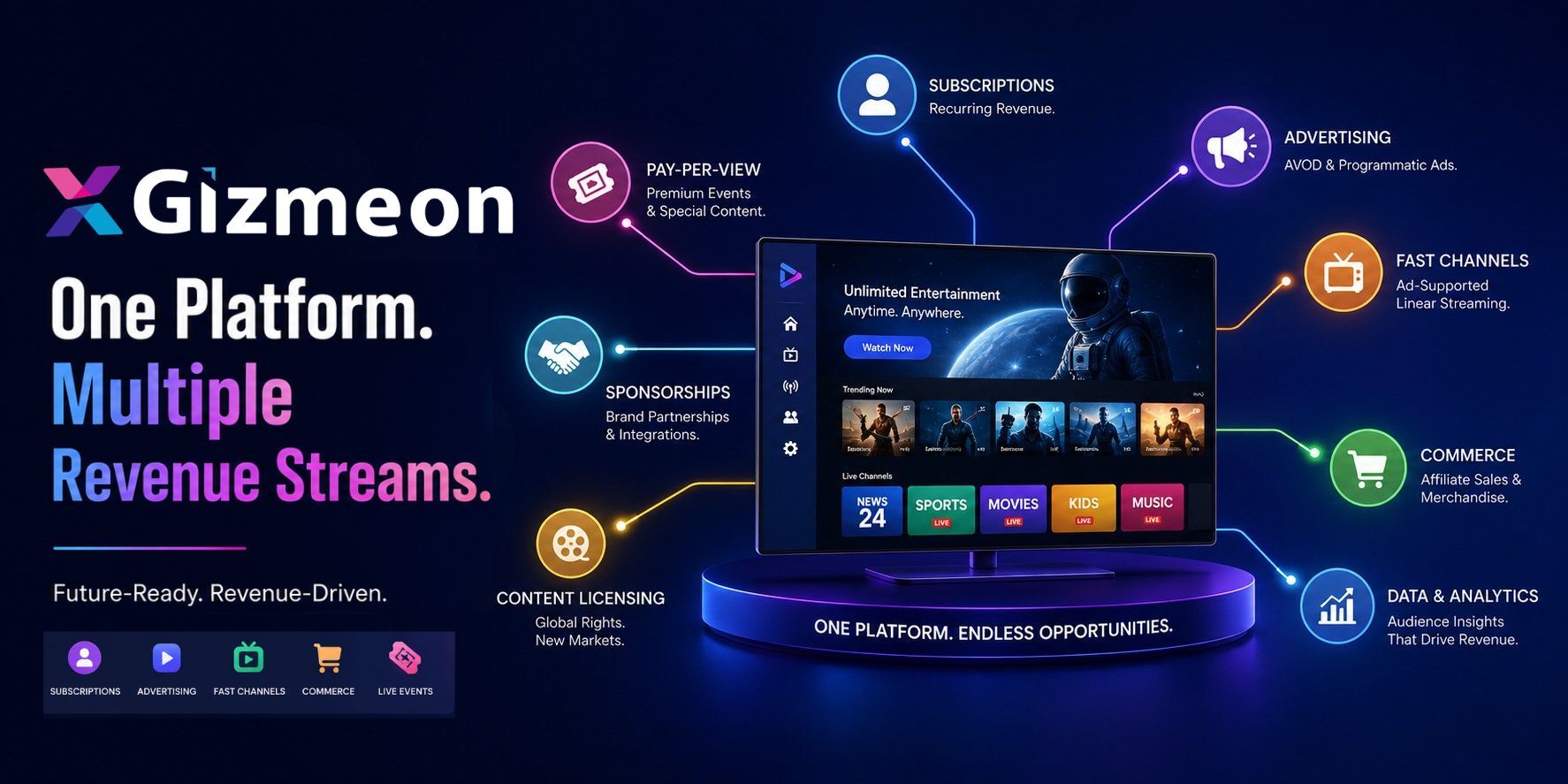
One of the biggest strategic mistakes streaming businesses continue to make is viewing monetization as a single decision. Either charge subscriptions. Or display advertisements. Or sell pay-per-view content. That mindset belongs to an earlier generation of streaming. Today’s highest-performing platforms understand that monetization is no longer about choosing one revenue model—it’s about intelligently combining several. Rather than depending on a single source of income, modern streaming businesses are building revenue stacks that allow different audience segments to engage in different ways. A single viewer might first discover free content supported by advertising before upgrading to a premium subscription. They may later purchase access to a live sporting event, watch a FAST channel between premium releases, engage with sponsored programming, or purchase merchandise through affiliate integrations. The audience hasn’t changed. The opportunities surrounding that audience have. This layered approach provides significantly greater business resilience while reducing dependence on any individual revenue stream. Some of the most effective monetization models now working together include:- Subscription Video on Demand (SVOD) for recurring premium memberships.
- Advertising Video on Demand (AVOD) for audiences preferring free access.
- Free Ad-Supported Television (FAST) Channels that create continuous advertising revenue.
- Transactional Video on Demand (TVOD) for premium events and exclusive releases.
- Brand sponsorships and integrated advertising experiences.
- Affiliate commerce connected directly to content.
- Content licensing across multiple territories.
- Live virtual events and premium community experiences.
Technology Is Becoming the Revenue Engine
If diversified monetization is the destination, technology is the vehicle that makes it possible. This is perhaps the biggest shift happening across the media industry today. Revenue is no longer created solely by content teams, advertising departments, or finance executives. Increasingly, it is being enabled—and limited—by technology. Consider a broadcaster that wants to launch a FAST channel. The business opportunity exists, but without infrastructure capable of creating, scheduling, distributing, and monetizing linear streaming channels, that opportunity remains unrealized. Similarly, a publisher may want to introduce personalized advertising, dynamic subscriptions, or AI-powered recommendations, but without the right MediaTech and AdTech capabilities, those revenue models never move beyond strategy presentations. Technology has evolved from supporting the business to actively driving it. This evolution has given rise to what many industry leaders now describe as Revenue Engineering—the practice of designing platforms where monetization is embedded into every layer of the user experience rather than being added as an afterthought. Revenue engineering changes how streaming platforms are built from the ground up. Instead of asking, “How do we deliver content?”, businesses now ask:- How can content be monetized differently for different audience segments?
- How can advertising become more relevant and more valuable?
- How can data improve both engagement and profitability?
- How can every interaction contribute to long-term business growth?
AI Is Quietly Becoming the Most Valuable Revenue Tool
Artificial Intelligence is often associated with content creation, automated editing, or synthetic media. While these applications continue to evolve, they represent only a fraction of AI’s commercial potential. The real transformation is happening behind the scenes. AI is rapidly becoming one of the most effective tools for increasing revenue—not by replacing people, but by helping businesses make smarter decisions faster than ever before. Instead of relying on historical reports and manual analysis, AI continuously studies audience behavior, identifies viewing patterns, predicts future actions, and recommends improvements that directly impact profitability. For example, AI can determine:- Which viewers are most likely to cancel their subscriptions before they actually do.
- Which advertisements generate the highest engagement for specific audience segments.
- Which content should be promoted to maximize viewing time.
- Which subscription plans deliver the highest customer lifetime value.
- Which markets present the strongest opportunities for expansion.
- Which content deserves additional marketing investment based on predicted engagement.
The Convergence of MediaTech and AdTech
Another defining trend shaping the industry’s future is the convergence of Media Technology and Advertising Technology. Historically, these existed as separate ecosystems. Media platforms focused on publishing and content delivery. Advertising platforms focused on campaign management and monetization. Today, those boundaries have largely disappeared. Modern streaming businesses require unified ecosystems capable of delivering exceptional viewing experiences while simultaneously managing advertising, audience intelligence, analytics, personalization, and revenue optimization. This convergence has accelerated innovation in areas such as:- Programmatic advertising that automates campaign delivery.
- Server-Side Ad Insertion (SSAI) for seamless viewing experiences.
- Dynamic Ad Insertion (DAI) based on audience behavior.
- Contextual advertising powered by AI.
- Cross-platform monetization across web, mobile, connected TV, and FAST channels.
- Real-time dashboards that connect viewer engagement directly with revenue performance.
The KPIs Every Media CEO Should Be Watching
Perhaps the clearest sign that the industry is evolving is the metrics executives choose to measure. For years, subscriber growth dominated every conversation. Today, those metrics provide only part of the picture. Forward-looking media organizations are placing greater emphasis on indicators that reflect long-term profitability rather than short-term growth. Increasingly, executive dashboards are prioritizing:- Revenue Per Viewer (RPV) – How much revenue each audience member generates across all monetization models.
- Lifetime Value (LTV) – The total value a viewer contributes throughout their relationship with the platform.
- Average Revenue Per User (ARPU) – A key indicator of monetization efficiency.
- Advertising Yield – The effectiveness of advertising inventory and campaign performance.
- Retention and Churn Rates – Measuring long-term audience loyalty rather than short-term acquisition.
- Engagement Quality – Understanding how meaningful viewer interactions translate into business outcomes.
The Future of Media Revenue
Streaming has entered a new chapter. The industry’s next wave of growth will not be driven solely by larger content libraries, bigger marketing budgets, or higher subscriber counts. It will be driven by businesses that understand how to transform every viewer interaction into multiple opportunities for engagement, monetization, and long-term value creation.This requires more than great content. It requires intelligent infrastructure capable of combining AI, analytics, AdTech, OTT technologies, hybrid monetization, and scalable media operations into one connected ecosystem.At Gizmeon, we believe this is the future of digital media. As an AI-first Media and AdTech company, our focus extends beyond helping organizations launch streaming platforms. We enable broadcasters, publishers, enterprises, and content owners to build intelligent revenue ecosystems through OTT solutions, FAST channel technology, AI-powered analytics, programmatic advertising, server-side ad insertion, and advanced monetization capabilities designed for the evolving media landscape. The companies that lead the next decade of streaming won’t necessarily be the ones with the most subscribers. They will be the ones with the smartest revenue strategy, the strongest technology foundation, and the ability to continuously adapt as audience behavior evolves. In the end, the future of media isn’t about finding more viewers. It’s about creating more value from every viewer you already have. That is where the next generation of competitive advantage will be built—and where the future of media revenue truly begins.