
A modern streaming platform is no longer defined by the number of apps it has. It’s defined by the architecture that powers them all.
To the average viewer, a streaming platform feels remarkably simple. Whether they open Netflix on an iPhone, continue watching on an Apple TV, or switch to a laptop later that evening, the experience appears seamless. Their watch history follows them, recommendations remain relevant, subscriptions stay intact, and playback resumes exactly where they left off. It feels like a single application that simply adapts to different screens. Behind the scenes, however, the reality is far more complex. A modern OTT platform is not one application—it is an ecosystem of independently built clients, backend services, APIs, databases, content pipelines, analytics engines, authentication systems, and media delivery infrastructure working together as a unified platform. Every device has different capabilities, operating systems, user interface paradigms, and playback requirements. Yet users expect a consistent experience regardless of where they choose to watch. This expectation has fundamentally changed how streaming platforms are engineered. Success is no longer determined by how quickly a company can build an Android or iOS application. Instead, it depends on designing an architecture capable of delivering a synchronized experience across every device while remaining scalable, secure, and future-ready. For technology companies building streaming ecosystems, including platforms like GIZMOTT by Gizmeon, this architectural approach has become the foundation of modern OTT engineering.The Biggest Misconception About OTT Platforms
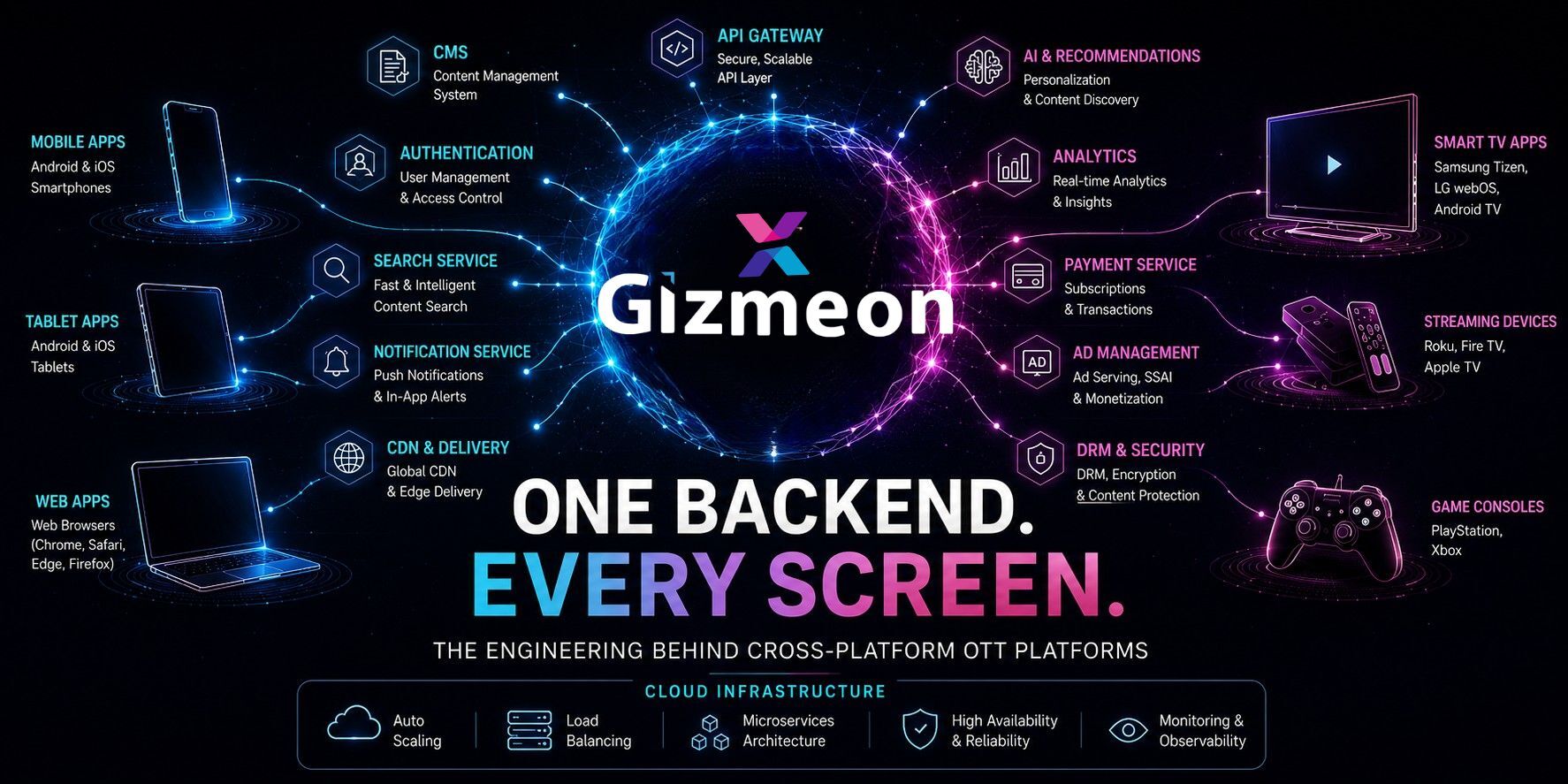
Many businesses beginning their streaming journey believe they need multiple applications—one for Android, another for iOS, separate applications for Android TV, Apple TV, Roku, Fire TV, Samsung Smart TVs, LG webOS, and the web. While this is technically true from a client development perspective, thinking of these as independent products creates unnecessary complexity. The real product is not the application. The real product is the platform behind it. Every application should simply act as a presentation layer that communicates with a centralized backend. Whether a viewer accesses content through a smartphone, Smart TV, streaming stick, or browser, every interaction should be driven by the same backend services. This architectural philosophy dramatically reduces duplication, simplifies maintenance, and ensures consistency across the entire streaming ecosystem.One Backend, Multiple Experiences
At the heart of every successful cross-platform OTT platform lies a centralized backend that acts as the single source of truth for the entire ecosystem. Rather than allowing each application to manage its own data or business logic, modern streaming platforms centralize core services, including:- Content Management System (CMS)
- User Authentication & Authorization
- Content Metadata Services
- Search Engine
- Recommendation Engine
- Playback Authorization
- Subscription & Payment Services
- Analytics & Viewer Insights
- Advertisement Management
- Notification Services
- Digital Rights Management (DRM)
Every Screen Speaks a Different Language
Although users expect identical experiences across devices, engineers know that every platform introduces its own unique technical challenges. An Android smartphone prioritizes touch interactions, portrait orientation, biometric authentication, and downloadable content. Apple TV focuses on remote navigation, focus-based interfaces, and tvOS-specific playback capabilities. Roku relies on BrightScript, has strict memory limitations, and follows a unique certification process. Samsung Smart TVs run on Tizen, LG televisions use webOS, while Fire TV introduces Amazon-specific integrations despite being Android-based. These differences extend far beyond the user interface. Each platform has its own media player behavior, DRM implementation, hardware decoding capabilities, caching mechanisms, storage limitations, accessibility requirements, remote control interactions, and operating system constraints. Engineering teams cannot simply copy the same application from one platform to another. Instead, they must build native experiences optimized for each ecosystem while ensuring they all communicate with the same backend architecture. This is what creates the illusion of one unified platform.APIs Are the Real Product
One of the most significant architectural shifts in modern OTT engineering is recognizing that applications should remain intentionally lightweight. Rather than embedding business logic inside every application, developers increasingly rely on API-driven architectures where the backend handles all intelligence. A modern streaming API typically manages:- User authentication
- Playback authorization
- Subscription validation
- Watch history
- Continue Watching
- Search
- Recommendations
- User profiles
- Device registration
- Advertisement requests
- Analytics collection
Content Synchronization Is Harder Than It Looks
One of the most overlooked engineering challenges is maintaining synchronized content across every device. Consider a viewer watching a live sporting event. They pause the stream on their tablet, later resume on their Smart TV, receive personalized highlights on their smartphone, and continue following related content through the web application. Behind this seemingly effortless experience lies continuous synchronization between multiple backend systems.- Content metadata must remain consistent.
- Playback positions must update instantly.
- Subscription permissions must remain valid.
- Recommendations must adapt in real time.
- Analytics must record every interaction without duplication.
Engineering for Performance at Scale
As streaming platforms grow, architecture becomes increasingly important. A platform supporting thousands of viewers can often function with relatively simple infrastructure. Supporting millions of concurrent users during a live sports final or major entertainment premiere requires an entirely different level of engineering. Scalable OTT platforms rely on multiple architectural components working together:- Distributed Content Delivery Networks (CDNs)
- Adaptive Bitrate Streaming (ABR)
- Intelligent caching strategies
- Load balancing
- Auto-scaling cloud infrastructure
- Database replication
- Queue-based processing
- Media transcoding pipelines
- High-availability storage
- Disaster recovery mechanisms
Maintaining Feature Parity Across Every Device
One of the most underestimated aspects of cross-platform development is maintaining feature consistency. Imagine introducing a seemingly simple capability such as AI-powered content recommendations. Engineering teams must now determine how that feature behaves across:- Android
- iOS
- Android TV
- Apple TV
- Roku
- Fire TV
- Samsung Smart TVs
- LG webOS
- Web browsers