
AI Doesn’t Understand Content—It Understands Metadata
One of the biggest misconceptions surrounding AI is that it understands video content the same way people do. It doesn’t. While computer vision and multimodal AI have made remarkable progress, AI does not inherently comprehend stories, emotions, audience intent, or narrative context. Instead, it interprets structured information that describes those elements. That information is metadata. Consider a viewer searching for: “Show me uplifting documentaries featuring female entrepreneurs.” A traditional content library may only describe a title using fields such as:- Genre
- Release Year
- Director
- Cast
- Language
- Was the documentary inspirational?
- Did it focus on entrepreneurship?
- Was sustainability a central theme?
- Did it feature women-led innovation?
Metadata Has Evolved Beyond Titles and Genres
For decades, metadata served primarily as a cataloging tool. A title, genre, language, runtime, and cast list were sufficient for organizing libraries and enabling keyword searches. Modern AI requires much more. Today’s audiences rarely search by genre alone. They search by mood, experience, context, intent, and emotion. A viewer might search for:- Feel-good family movies
- Fast-paced thrillers without graphic violence
- Documentaries about renewable energy
- Inspirational stories about resilience
- Business documentaries under one hour
- Themes and story arcs
- Emotional tone
- Character relationships
- Audience suitability
- Scene descriptions
- Dialogue topics
- Visual objects
- Locations
- Pace and intensity
- Music styles
- Cultural references
- Accessibility information
- Brand safety classifications
- Product appearances
- Sports highlights
- Events and moments
How Metadata Powers Every AI Experience
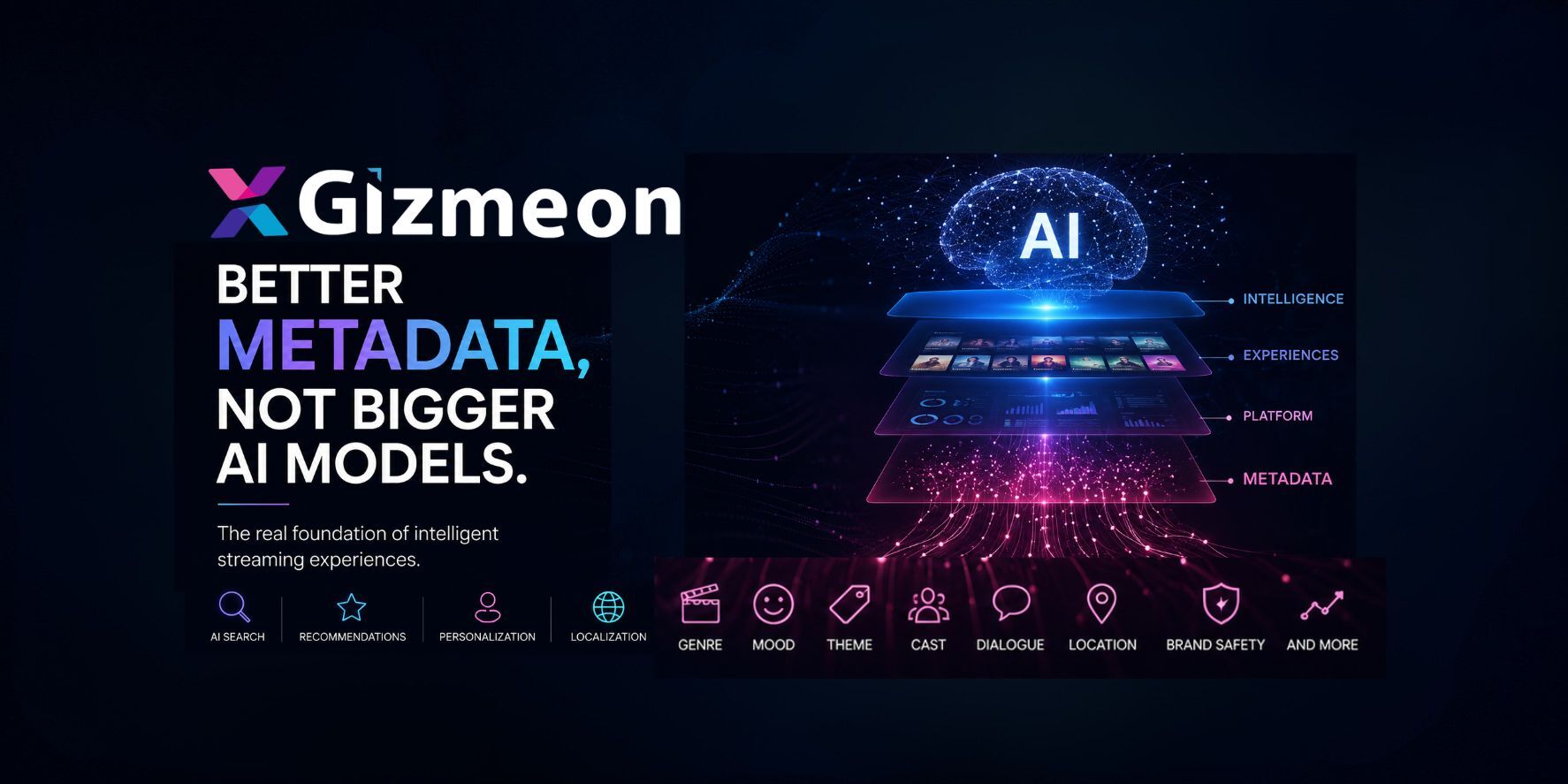
Every intelligent media experience begins with one capability: understanding content. Whether the goal is discovery, personalization, advertising, or localization, AI depends on metadata to interpret relationships and make informed decisions.AI Search
Search has evolved dramatically over the past decade. Traditional search engines matched keywords. Modern AI search interprets meaning. Instead of typing a movie title, users increasingly ask questions in natural language: “Recommend documentaries about climate innovation.” “Show me inspiring sports stories.” “Find courtroom dramas with strong female leads.” Semantic search enables AI to understand user intent rather than exact wording. However, semantic understanding only works when the content itself has been described with sufficient depth. Rich metadata allows AI to connect user intent with relevant content, dramatically improving content discovery and reducing search friction.AI Recommendations
Recommendation engines do much more than compare viewing histories. The best recommendation systems identify relationships between pieces of content. Two films may belong to different genres but share similar themes, pacing, storytelling style, emotional tone, or audience appeal. Metadata exposes these hidden relationships. Instead of recommending content simply because other viewers watched it, AI begins recommending titles because they genuinely share meaningful characteristics. This creates recommendations that feel thoughtful rather than repetitive.AI Personalization
Every viewer watches content for different reasons. One person enjoys documentaries because they love science. Another prefers them because of entrepreneurship. A third values inspirational human stories. Although all three viewers watch the same title, their motivations differ. Metadata allows AI to recognize these multiple dimensions and personalize recommendations based on interests rather than viewing history alone. This transforms personalization from behavioral prediction into genuine content understanding.Localization
Localization is often misunderstood as translation.Translation changes language. Localization creates relevance.Successful global streaming platforms must understand cultural context, regional interests, audience preferences, and market-specific trends. Rich metadata enables AI to present content differently across different markets while maintaining relevance for each audience. This improves international discovery and engagement without changing the underlying content itself.
AI Advertising
Advertising is shifting from demographic targeting toward contextual intelligence. Brands increasingly care about where advertisements appear, not simply who watches them. A luxury automotive brand may prefer documentaries about innovation. A travel company may seek adventure programming. A wellness brand may align with health-focused content. Metadata enables AI to understand the environment surrounding every advertisement, creating safer, more relevant, and more effective advertising opportunities. Rather than relying solely on audience profiles, contextual advertising uses metadata to understand the content itself.Why Bigger AI Models Won’t Be the Competitive Advantage
Artificial intelligence is becoming increasingly democratized. Organizations can now access powerful models from OpenAI, Google Gemini, Anthropic Claude, and a growing ecosystem of open-source alternatives. Capabilities that once required enormous research budgets are now available through cloud services and APIs. This is good news for innovation. It also changes the nature of competition. When powerful AI becomes widely available, technology alone is no longer a sustainable differentiator. The competitive question shifts from: “Which model are you using?” to: “What unique knowledge does your AI have access to?” That knowledge comes from proprietary metadata. Every media organization possesses valuable institutional knowledge about its content, audiences, and editorial decisions. Rich metadata captures that knowledge in a structured form that AI can understand. This becomes increasingly valuable because it cannot be replicated overnight. Competitors can adopt the same AI model. They cannot instantly replicate years of carefully structured metadata, editorial expertise, audience insights, and content relationships. As AI models continue improving, metadata becomes the lasting competitive advantage. Organizations investing today in metadata quality are building assets that will continue creating value regardless of which AI model dominates tomorrow.What This Means for Media Companies
For media companies, the implications go beyond improving search or recommendations. The quality of metadata increasingly determines how effectively AI can work across the entire content lifecycle—from ingestion and organization to discovery, personalization, localization, and monetization. As an AI first Media and Ad-Tech company, Gizmeon’s work with media and entertainment companies has reinforced a simple observation: building an AI-enabled streaming experience is not just about integrating AI capabilities. It is about giving those capabilities the right context to work with. When content is structured with richer metadata, AI can understand more than what a title is; it can understand its themes, audience, context, relationships, and potential use cases. This changes the role of metadata from a backend content-management function into a strategic technology asset. As media companies build increasingly intelligent digital experiences, the ability to structure and enrich their content will become just as important as the AI models they choose to deploy.The Future of AI Belongs to Organizations That Understand Their Content
The next generation of AI will transform how audiences discover and interact with media. Conversational search will replace traditional search boxes. Voice assistants will understand increasingly complex requests. Viewers will search for scenes rather than titles. AI will generate personalized trailers, create intelligent content summaries, surface archive footage instantly, and recommend programming based on mood, context, and intent. These experiences may appear very different on the surface. They all depend on the same foundation. Metadata. Every new AI capability requires structured information describing the content in greater detail than ever before. Without that information, AI becomes less accurate, less personalized, and less trustworthy. Media organizations are gradually shifting from managing content libraries to managing knowledge libraries. The distinction is significant. Content libraries store assets. Knowledge libraries enable intelligence. Organizations that successfully transform their content into structured knowledge will be positioned to deliver richer search experiences, stronger personalization, more effective advertising, improved localization, and entirely new AI-powered services as the technology continues to evolve.Conclusion
Artificial intelligence is undoubtedly reshaping the future of digital media. It is improving search, recommendations, personalization, localization, advertising, and countless other experiences that audiences now expect. But AI does not create intelligence in isolation. It depends on the quality of the information it receives. Larger models may process more information and generate increasingly sophisticated outputs, but they cannot compensate for context that was never captured. Metadata is no longer just a way to organize content. It has become the foundation that enables AI to understand relationships, interpret intent, deliver relevant recommendations, personalize experiences, optimize advertising, and unlock deeper audience engagement. As AI continues to mature, access to powerful models will become increasingly common. Rich, well-structured metadata will remain unique. The organizations that invest in understanding their content—not simply processing it—will be the ones that define the next generation of intelligent media experiences. In the AI era, bigger models may improve performance.Better metadata will define leadership.