The New AdTech Stack: What It Takes to Build Intelligent Advertising Platforms

The New AdTech Stack: What It Takes to Build Intelligent Advertising Platforms
As advertising becomes increasingly digital, privacy-conscious, contextual, and AI-driven, the real competitive advantage is moving beneath the campaign layer—in the technology architecture that powers audience intelligence, creative personalization, ad delivery, measurement, and optimization. For much of the last decade, the advertising industry has focused on programmatic buying, audience targeting, third-party data, demand-side platforms, and increasingly sophisticated media optimization. Advertisers invested heavily in technologies designed to identify the right audience, deliver advertisements at scale, and measure campaign performance. While this architecture transformed digital advertising, the environment in which it operates is changing rapidly. Third-party cookies are disappearing. Privacy regulations are becoming more sophisticated. Consumers are moving between connected television, mobile devices, streaming platforms, retail environments, social media, and digital publishers. At the same time, artificial intelligence is changing how audiences are understood, how advertising creative is produced, and how campaigns are optimized. These changes are creating a new generation of AdTech architecture. The future advertising stack will not simply connect demand-side platforms, supply-side platforms, data platforms, and measurement tools. It will increasingly combine AI agents, audience intelligence, data clean rooms, contextual engines, creative AI, server-side ad insertion (SSAI), measurement infrastructure, and automated optimization into a connected technology ecosystem. For CEOs, CTOs, CPOs, and advertising leaders, this represents an important strategic shift. The question is no longer simply whether an organization has an AdTech stack. The question is whether that stack has been engineered to operate in a world where identity is becoming less important, context is becoming more valuable, and AI is becoming part of every stage of the advertising lifecycle. The future of advertising will be defined as much by intelligent infrastructure as by media strategy.

Advertising Is Becoming an Engineering Challenge

It is tempting to think of AdTech as a collection of tools that help marketers purchase advertising inventory and reach audiences. In reality, modern advertising requires a highly interconnected technology ecosystem. A single digital advertising experience can involve audience data, contextual signals, creative assets, bidding systems, content environments, ad servers, streaming infrastructure, attribution platforms, and optimization engines. The engineering challenge is to make these systems operate together without compromising performance, privacy, or user experience. Modern advertising platforms increasingly need to support:
  • Privacy-conscious audience intelligence across fragmented data environments.
  • Real-time contextual analysis of content and user environments.
  • AI-powered creative generation and personalization.
  • Programmatic advertising across multiple inventory sources.
  • Server-side ad insertion for connected television and streaming.
  • Cross-channel measurement and attribution.
  • Automated campaign optimization based on real-time performance signals.
Each component solves a different problem. The real competitive advantage comes from connecting them. An advertiser may have access to sophisticated audience data, for example, but that data has limited value if it cannot inform contextual decisions, creative personalization, media buying, and campaign measurement. This is why the next generation of AdTech will be defined by architecture rather than individual features.

Audience Intelligence Is Replacing Traditional Targeting

For years, digital advertising relied heavily on audience segmentation. Advertisers attempted to identify users based on demographics, browsing behaviour, interests, device identifiers, and other signals. These approaches created highly targeted advertising environments, but they also created increasing dependence on personal identifiers and third-party data. The advertising ecosystem is now moving toward a different model. Audience intelligence is becoming more important than simple audience targeting. Instead of asking whether a particular individual belongs to a predefined audience segment, intelligent advertising systems can evaluate a broader combination of signals to understand intent, interests, behaviour, and context. This can include:
  • First-party data collected through consent-based interactions.
  • Aggregated behavioural insights.
  • Content consumption patterns.
  • Contextual signals.
  • Engagement and conversion data.
  • Predictive audience models.
  • Real-time campaign performance.
AI can transform these signals into a continuously evolving understanding of audience behaviour. For example, a travel advertiser may not need to identify an individual as a “frequent traveller.” An intelligent system could identify that a particular content environment, engagement pattern, and contextual moment indicate strong travel intent. This represents an important shift from identity-based advertising toward intelligence-based advertising. For advertisers, the advantage is not simply greater privacy. It is the ability to understand audiences without relying entirely on persistent individual identities.

AI Agents Will Change How Campaigns Are Managed

Artificial intelligence is already being introduced across advertising platforms, but the next major evolution will involve AI agents in AdTech. Traditional campaign management requires multiple teams to make decisions across different stages of the advertising lifecycle. Media planners establish campaign strategies. Traders manage buying. Creative teams develop assets. Analysts interpret performance. Marketing teams adjust campaigns based on results. AI agents can increasingly connect these activities. A future advertising architecture could include specialized agents responsible for:
  • Identifying emerging audience opportunities.
  • Evaluating media inventory and buying conditions.
  • Generating and adapting creative assets.
  • Monitoring campaign performance.
  • Identifying anomalies and performance changes.
  • Recommending budget reallocations.
  • Optimizing campaigns against predefined business objectives.
The objective is not to remove humans from advertising. It is to reduce the amount of manual operational work required to manage increasingly complex campaigns. The role of advertising teams can therefore move toward strategy, brand governance, creative direction, and business decision-making while AI systems manage more of the continuous operational complexity. This could fundamentally change campaign optimization from a periodic activity into a continuous process.

Data Clean Rooms Will Become Core AdTech Infrastructure

Privacy is becoming one of the defining challenges of modern advertising. Advertisers still need to understand campaign reach, audience overlap, conversion behaviour, and business outcomes. However, they increasingly need to accomplish this without unrestricted access to individual-level consumer information. This is where data clean rooms become strategically important. A data clean room allows organizations to collaborate and analyse data within controlled environments without directly exposing sensitive information. For advertising ecosystems, this creates opportunities for collaboration between:
  • Advertisers and publishers.
  • Brands and streaming platforms.
  • Retailers and media companies.
  • Agencies and technology providers.
  • Measurement platforms and content owners.
Clean rooms can help organizations evaluate audience overlap, campaign performance, conversion behaviour, and other advertising signals while maintaining stronger privacy controls. The next evolution will involve combining clean rooms with AI. Rather than simply enabling data collaboration, clean room environments can become part of an intelligent decision-making infrastructure where AI models extract insights from privacy-safe datasets. This will be particularly important for CTV advertising, retail media, programmatic advertising, and cross-platform measurement, where multiple organizations need to collaborate without necessarily sharing raw customer data.

Contextual Intelligence Will Become More Important

Privacy-conscious advertising does not mean less relevant advertising. It means relevance needs to be created differently. This is where contextual advertising is becoming increasingly important. Traditional contextual targeting may identify the topic of a webpage and match advertisements accordingly. Modern contextual engines can go much further. AI can analyse content, sentiment, visual signals, subject matter, viewing environments, and emerging trends to determine whether a particular advertising environment is relevant to a brand. Consider a viewer watching a streaming programme focused on entrepreneurship. A contextual engine could recognize that the environment is relevant to financial services, productivity software, professional education, business technology, or other related categories without requiring the advertiser to know exactly who the viewer is. The advertisement becomes relevant because of what is happening in the moment. This makes contextual intelligence particularly valuable as advertisers adapt to a more privacy-conscious ecosystem. The future of targeting may therefore involve less dependence on knowing everything about the individual and greater intelligence about the environment in which the advertisement appears.

Creative AI Is Turning Advertising Into a Dynamic System

Advertising creative has traditionally operated on a relatively slow production cycle. A campaign is planned, creative assets are produced, variations are approved, and those assets are distributed across multiple platforms. Generative AI is changing this process. Creative AI can help advertisers generate, adapt, localize, resize, and personalize advertising assets at significantly greater speed. However, the real opportunity appears when creative AI is connected to audience intelligence and contextual engines. Instead of producing a fixed set of advertisements, advertising platforms can increasingly adapt creative based on:
  • Audience characteristics and behavioural signals.
  • Content and contextual environments.
  • Geographic markets.
  • Device and screen formats.
  • Campaign performance.
  • Product or promotional priorities.
One audience may respond more strongly to product benefits, while another may respond to price or convenience. One market may require localized messaging, while another may require a completely different creative approach. The technology can support these variations without requiring every asset to be created manually. The objective is not to generate as many advertisements as possible. It is to build advertising systems capable of delivering the right message, in the right format, within the right context.

CTV Advertising Is Making SSAI Increasingly Important

The rapid growth of streaming has introduced another important architectural requirement. Connected TV advertising operates differently from traditional digital advertising because the viewing experience is closer to television than conventional web browsing. This makes server-side ad insertion (SSAI) increasingly important. SSAI allows advertisements to be stitched into the content stream at the server level, creating a more seamless viewing experience and enabling greater control over ad delivery within streaming environments. For modern streaming platforms, SSAI can support:
  • Dynamic advertising insertion.
  • Programmatic CTV advertising.
  • Personalized ad experiences.
  • Improved playback continuity.
  • Cross-device advertising delivery.
  • More consistent measurement.
The opportunity becomes even more significant when SSAI is connected to audience intelligence, contextual engines, creative AI, and measurement systems. Instead of treating ad insertion as a standalone technical function, it becomes part of a larger intelligent advertising architecture. For streaming platforms, broadcasters, and media companies, this creates an opportunity to make television advertising more measurable and adaptive while maintaining the premium viewing experience audiences expect from connected television.

Measurement Must Move Beyond the Click

One of the biggest challenges facing the advertising industry is measurement fragmentation. Advertisers operate across search, social media, programmatic advertising, connected television, retail media, audio, mobile applications, and digital publishers. Each environment can use different measurement methodologies. This makes it difficult to understand the actual contribution of each channel to business outcomes. The future AdTech stack therefore requires a more unified measurement architecture. Rather than relying exclusively on clicks or last-touch attribution, modern measurement systems need to evaluate:
  • Incremental conversions.
  • Reach and frequency.
  • Brand lift.
  • Customer acquisition cost.
  • Return on advertising spend.
  • Customer lifetime value.
  • Cross-channel contribution.
AI can help identify relationships across these signals and uncover patterns that traditional reporting systems may not detect. The goal is no longer simply to determine which advertisement received the final click. It is to understand how audience, context, creative, media exposure, frequency, and timing collectively contributed to a business outcome. This distinction will become increasingly important as advertising becomes more fragmented across digital and connected environments.

Optimization Becomes a Continuous Feedback Loop

Measurement becomes significantly more valuable when it feeds directly back into campaign optimization. This is where the different components of the new AdTech stack begin to operate as a single system. A modern optimization engine can continuously evaluate campaign performance and identify opportunities to adjust media allocation, creative, audience strategies, frequency, and inventory selection. The architecture begins to resemble a continuous feedback loop: Audience Intelligence → Context → Creative → Ad Delivery → Measurement → Optimization The outcome of one stage becomes an input for the next. For example, if a particular creative performs strongly within a specific contextual environment, the system can identify that relationship and adjust future campaign decisions. Similarly, if a particular audience segment shows declining engagement, the optimization layer can identify the change and recommend adjustments to messaging, frequency, or media allocation. This creates an advertising ecosystem capable of learning continuously rather than relying on manual campaign reviews at fixed intervals.

What the New AdTech Stack Looks Like

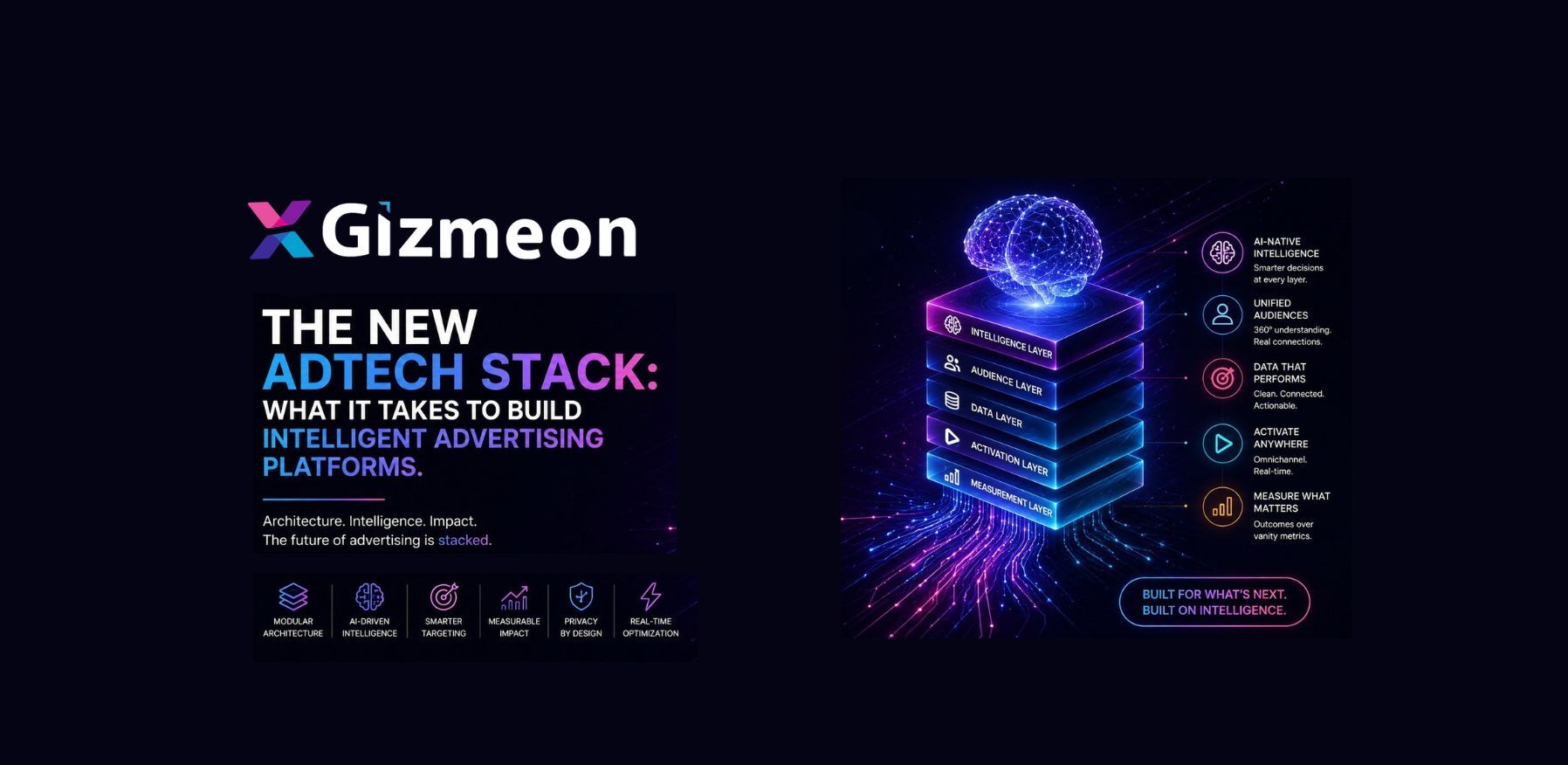
The future advertising architecture can be understood as several interconnected layers.

1. Data and Privacy Layer

First-party data, consent management, clean rooms, privacy-enhancing technologies, and identity solutions provide the foundation for responsible data collaboration.

2. Intelligence Layer

AI agents, audience intelligence, predictive analytics, and machine learning transform available signals into actionable insights.

3. Context Layer

Contextual engines analyse content, sentiment, environments, and consumption signals to determine where advertising will be most relevant.

4. Creative Layer

Generative AI and dynamic creative optimization create and adapt advertising assets across audiences, formats, markets, and environments.

5. Activation Layer

Programmatic platforms, publishers, connected television, streaming services, retail media, and SSAI deliver advertisements across channels.

6. Measurement Layer

Unified measurement evaluates reach, frequency, attribution, incrementality, conversions, and broader business outcomes.

7. Optimization Layer

AI-powered optimization continuously connects performance signals back into audience, creative, contextual, and media decisions. Together, these layers create something fundamentally different from the traditional advertising technology stack. They create an intelligent advertising operating system.

Conclusion

The advertising industry is entering a new phase where success will no longer depend simply on reaching the right audience, but on understanding audiences, interpreting context, delivering relevant creative, measuring meaningful outcomes, and continuously optimizing every interaction. As privacy requirements increase, media environments become more fragmented, and AI becomes embedded across the advertising lifecycle, organizations will need intelligent infrastructure capable of connecting audience intelligence, contextual advertising, creative AI, clean rooms, SSAI, measurement, and optimization into a single ecosystem.  At Gizmeon, we believe the future of advertising lies at the intersection of AI, media, AdTech, and intelligent content delivery. As an AI-first Media and AdTech company, Gizmeon builds technology that helps media companies, broadcasters, and content owners create, operate, and monetize modern digital video ecosystems through solutions spanning OTT, FAST, programmatic advertising, SSAI, audience analytics, and AI-powered media workflows. As the advertising ecosystem continues to evolve, the organizations that invest in intelligent, adaptable, and AI-ready infrastructure will be best positioned to capture the next generation of media monetization. The future of advertising will not simply be about delivering more ads; it will be about building smarter systems that understand, deliver, measure, and continuously optimize every advertising experience.

Related Posts
Leave a Reply

Your email address will not be published.Required fields are marked *