
Part 1: Dashboards Tell You What Happened. AI Agents Ask Why.
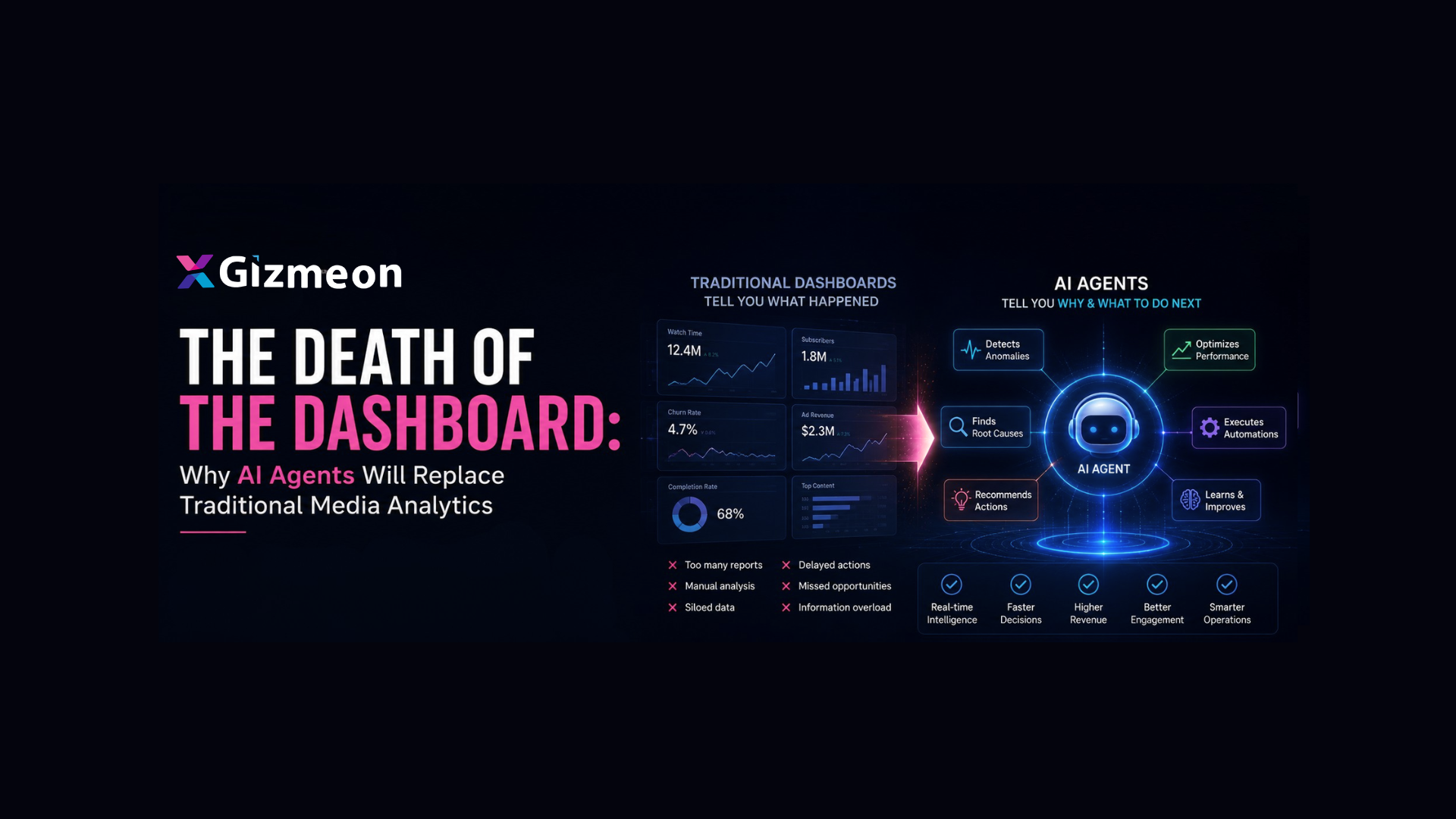
The traditional analytics dashboard was designed around a simple question: What happened? How many people watched? How long did they watch? What was the completion rate? Which content generated the most engagement? How much advertising revenue was generated? These metrics remain important. But in a fragmented streaming ecosystem, knowing what happened is no longer enough. Imagine that an OTT platform notices that viewing hours dropped 12% yesterday. A traditional analytics platform might highlight the decline in a red graph. An analyst then needs to investigate. Was there a technical issue? Did a popular series end? Did users experience buffering? Did a competitor launch new content? Did engagement decline within a particular geography? Did advertising frequency increase? The dashboard can show hundreds of data points, but it does not necessarily connect them into an explanation. An AI analytics agent, however, can be designed to operate differently. It could examine viewing behaviour, content performance, platform logs, device data and advertising activity simultaneously. It could identify that the decline came primarily from mobile users in one market, correlate it with an increase in playback errors and flag the issue for the operations team. The difference is subtle but powerful. Dashboards present information. AI agents interpret information. This is particularly important for streaming platforms because the number of signals being generated continues to increase. A modern OTT ecosystem can involve content metadata, viewing behaviour, advertising data, device information, subscription activity, first-party audience data, CDN performance and operational telemetry. Gizmeon’s approach to AI-first media infrastructure reflects this shift. Its Agentic AI Hub includes agents for content operations, ad optimization, viewer personalization and platform monitoring rather than treating AI as simply another reporting layer. The dashboard is therefore not necessarily disappearing overnight. It is becoming something different: a surface for humans to supervise intelligent systems rather than manually interpret every signal.Part 2: From Reporting to Reasoning
The biggest limitation of traditional media analytics is not the amount of data available. It is the gap between data and action. Consider an advertising campaign running across a FAST channel. A traditional workflow might look like this: The campaign manager checks performance → notices declining CPM → opens another analytics tool → investigates audience composition → checks inventory → speaks to the ad operations team → adjusts the campaign → waits for the next reporting cycle. Every step introduces delay. AI agents can potentially compress that workflow. An agent could continuously monitor campaign performance, compare it against historical benchmarks, identify changes in audience behaviour, evaluate available inventory and recommend an optimization. With the right permissions and governance, it could eventually execute the change itself. This is the transition from analytics to orchestration. Instead of asking: “What happened to our CPM?” A media executive could ask: “Why did CPM decline, and what should we change?” The second question is much closer to a business decision. This is why AI agents for media and advertising are becoming more relevant. Recent work across the advertising industry points toward AI systems coordinating workflows involving audience understanding, campaign execution, measurement and optimization rather than simply generating reports. For streaming companies, the possibilities extend well beyond advertising. An AI agent could monitor content performance and identify titles with unusually high completion rates. It could detect a sudden increase in churn among a particular audience segment. It could identify that a piece of content is performing particularly well in one geography and recommend localization or promotion. It could monitor infrastructure and identify patterns that indicate a potential outage before viewers experience it. This creates a fundamentally different operating model. The analytics system doesn’t simply tell the team what happened. It helps the team decide what happens next. That distinction will become increasingly important as media companies operate across more platforms, devices, markets and monetization models.Part 3: The Rise of the AI-Native Media Stack
Replacing dashboards with AI agents does not mean simply adding a chatbot to an existing analytics platform. The bigger opportunity is to redesign the underlying media technology stack around intelligence. That means connecting data, analytics, AI agents and execution layers so that information can move continuously through the system. Consider a modern streaming environment. At the data layer, the platform collects first-party viewing data, content metadata, advertising signals and operational information. At the intelligence layer, machine learning models and AI agents interpret those signals. At the decision layer, the system determines what action could improve the outcome. At the execution layer, that decision is applied to advertising, recommendations, content operations or platform infrastructure. Then the result feeds back into the system. This creates a continuous intelligence loop: Observe → Understand → Decide → Act → Measure → Learn That is fundamentally different from the traditional: Collect → Report → Review → Act The second model depends heavily on humans moving information between systems. The first is designed for continuous machine-assisted decision-making. Gizmeon is building toward this model through its AI-first media and AdTech architecture, where production-grade agents are being embedded across areas including content operations, ad optimization, personalization and platform monitoring. The implications for OTT analytics are significant. Imagine a streaming platform where an AI agent notices that viewers are abandoning a particular episode at the same timestamp. Instead of simply reporting the completion rate, it could investigate whether the drop correlates with a technical playback issue, content characteristic or advertising interruption. Another agent could identify that viewers who finish a particular series are significantly more likely to watch another category and automatically recommend that content to the relevant audience. An advertising agent could detect changing demand and adjust optimization parameters based on performance and available inventory. An operations agent could detect infrastructure anomalies and escalate or resolve routine incidents. This is the beginning of agentic media infrastructure. And it changes what companies should expect from their analytics platforms. The question is no longer: “How many dashboards do we have?” It becomes: “How many business decisions can our infrastructure intelligently support?”Part 4: The Dashboard Isn’t Dead. The Dashboard-Only Model Is.
There is an important distinction here. Dashboards are not going away. Executives will still want to see revenue. Product teams will still need engagement metrics. Ad operations teams will still monitor delivery. Engineers will still need observability tools. The problem is expecting humans to manually interpret every signal generated by increasingly complex media systems. That model does not scale. As streaming businesses expand into FAST, CTV, AVOD, SVOD, live streaming and hybrid monetization, the complexity of the underlying ecosystem increases. Media companies are already looking beyond subscriber counts toward engagement, revenue and more sophisticated performance indicators. Gizmeon’s recent work on streaming KPIs and intelligent AdTech reflects this broader industry shift. The future dashboard may therefore look less like a spreadsheet and more like a command centre. Instead of displaying 50 charts, it could surface five decisions that require attention. Instead of saying:“Churn increased 8%.”It could say:
“Churn increased 8% among users who joined in the last 30 days. The strongest correlation is reduced engagement after the first session. Here are three recommended interventions.”Instead of:
“Ad revenue declined.”It could say:
“Ad revenue declined 6% despite stable viewing hours. Fill rate decreased on two FAST channels. Increasing demand-source allocation is projected to recover approximately X% of lost yield.”That is the difference between business intelligence and business action. And it is why the future of media analytics will not simply be about better visualizations. It will be about better decisions. The companies that benefit most from AI will not necessarily be those with the largest number of models. They will be the ones capable of connecting AI to reliable first-party data, strong infrastructure, clear business objectives and measurable workflows. This is also why AI implementation cannot happen as a disconnected layer on top of an outdated technology stack. Gizmeon’s AI Advisory practice, for example, focuses on identifying where AI agents and automation can generate measurable operational or revenue impact before companies begin building. The goal should not be to make every process autonomous. The goal should be to identify which decisions are repetitive, data-intensive and sufficiently well-defined to be delegated to machines, while keeping humans responsible for strategy, governance and high-stakes decisions.